


How Much Is the Monthly Electricity Bill for an RO Water Purifier? What Is the Wastewater Ratio? 2026 Calculation Formulas and Comparison Table
Direct answer:Based on 5 liters of drinking water per day, the monthly electricity cost of an instant-heating RO water purifier is approximately HK$15–40; in terms of the wastewater ratio, a typical household RO purifier discharges 0.5–3 liters of wastewater for every 1 liter of purified water produced (i.e. 1:0.5 to 1:3). In other words, water bills are the main variable cost, not electricity. The formulas below let you plug in your own electricity and water rates.
Which three numbers matter most?
- Most of the electricity used to produce water comes from the booster pump and heating: the booster pump uses approximately 30–60W, while instant heating can momentarily reach 2,000–3,000W (but it only heats for several dozen seconds each time).
- Wastewater ratio 1:0.5 to 1:3 is a common range for household units; the worse the ratio, the higher the long-term water bill.
- At 5 liters per day and a wastewater ratio of 1:2, approximately 300 liters of wastewater is discharged each month — equivalent to 0.3 cubic meters.
| 1 HK$ = | S$ SGD | A$ AUD | £ GBP | US$ USD |
|---|---|---|---|---|
| Reference exchange rate | S$0.16332 | A$0.18128 | £0.09565 | US$0.12748 |
How is the electricity cost calculated? (Plug in your figures directly)
Formula:Monthly electricity cost = (Booster pump wattage × water production hours per day + heating wattage × heating minutes per day ÷ 60) ÷ 1000 × 30 × your electricity rate
Example (for illustration only, not your actual bill): Booster pump 45W, operating 1 hour per day; heating 2,200W, a cumulative 6 minutes per day; electricity rate HK$1.3/kWh.
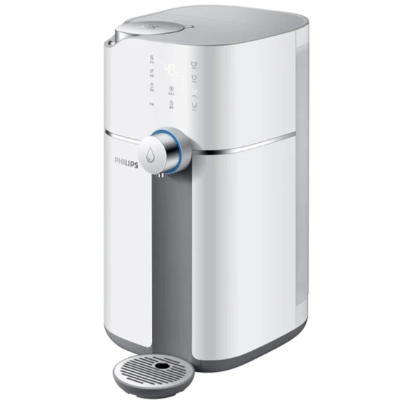
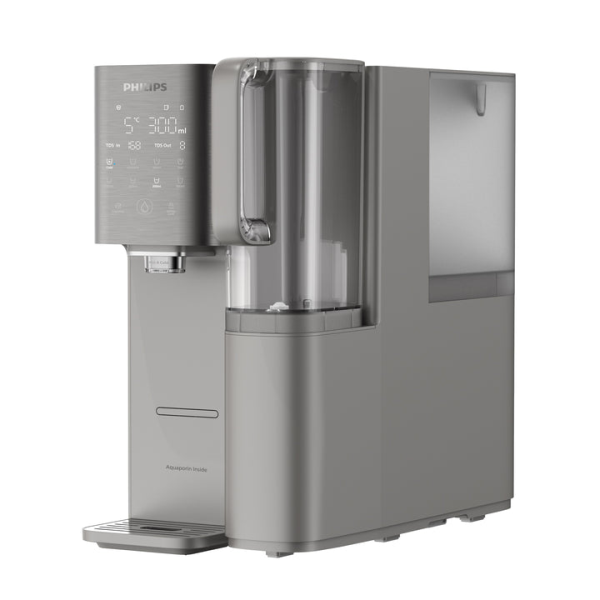
💡 How much does the Philips RO water purifier cost? (Our store's actual price on 2026-10-28)
The following prices are automatically generated by our SHOPLINE product API (2026-10-28) to help you calculate the total cost of ownership, including both electricity and the machine price. Only currently listed models are shown; the checkout page shall prevail.
How much do filters cost per year?
The total cost of an RO machine should include the filters. Assuming 1–2 replacements per year, annual filter expenses are approximately 12–38% of the machine price:
Instant heating is more energy-efficient than storage heating becauseThere is no need to keep the water warm: Storage-type units need to maintain the temperature of the inner tank, and standby power consumption can account for more than half of total energy consumption. This is one of the most easily overlooked factors when choosing a machine.
How does the wastewater ratio affect water bills?
Formula:Monthly water usage = Drinking water consumption × (1 + Wastewater ratio). Based on 5 liters per day and 30 days per month:
The actual cost of 0.375 cubic metres of water in Hong Kong is very small;the real cost difference lies in filter lifespan —— Machines with a poorer wastewater ratio put a greater load on the pre-filters, requiring more frequent replacement. This is more worth calculating than the water cost.
Why do some people say that “RO water dispensers consume a lot of electricity”?
In most cases, they are confusing “instantaneous power” with “continuous power”. Instant-heating models may use 2,000–3,000W momentarily, which sounds alarming, but they only operate for a few dozen seconds each time, resulting in just single-digit kWh per month. In contrast,the insulation function of traditional storage-type machines is the real source of long-term power consumption。
Another misconception is that the machine is “producing water continuously”. A normal machine stops once the water tank is full and only resumes water production after water is dispensed. If the machine keeps running nonstop, it is usually due to an inlet water pressure issue or a faulty float valve. This is a maintenance problem, not normal power consumption.
How can you find out the actual figures for your machine?
Here are three methods, from easiest to most difficult:① Use a power meter (plug-in type) to measure the water dispenser’s consumption for 24 hours;② Check the rated power and daily water production listed on the product specifications page, then estimate using the formula above;③ Compare two electricity bills (but changes in other household appliances may interfere, making this the least accurate method).
The wastewater ratio can be measured directly: use a graduated container to collect the purified water and wastewater while timing them. The ratio between the two is your actual wastewater ratio. This is the most reliable method.
What other common questions are there?
Is the monthly electricity bill for an RO water dispenser really less than $50?
Based on 5 litres per day and an instant-heating model, it is usually $15–40. Usage-intensive models or storage-type models will cost more; enter your electricity rate and usage into the formula for the actual estimate.
Can wastewater be reused?
Yes. It can be used for mopping floors, flushing toilets and watering plants. It is not recommended for drinking or cooking.
Does the wastewater ratio get worse over time?
Yes. When the filters become clogged or the water pressure drops, the wastewater ratio usually increases. This is one of the signs that the pre-filters need to be replaced.
Are instant-heating models always more energy-efficient than storage-type models?
This applies when drinking small amounts frequently; if you draw a large amount of hot water at once, the difference will be smaller.
Sources and Methodology
Calculation method: All figures in this article are derived from publicly available physical formulas (power × time = energy), not measured by the manufacturer. The assumed values (45W pump, 2,200W heating, 6 minutes of heating per day, $1.3/kWh) are clearly identified as examples in the article. Users should substitute the actual electricity rate on their electricity bill and their machine’s specifications.The actual model specifications and prices of products sold by our store can be found on each product page.