


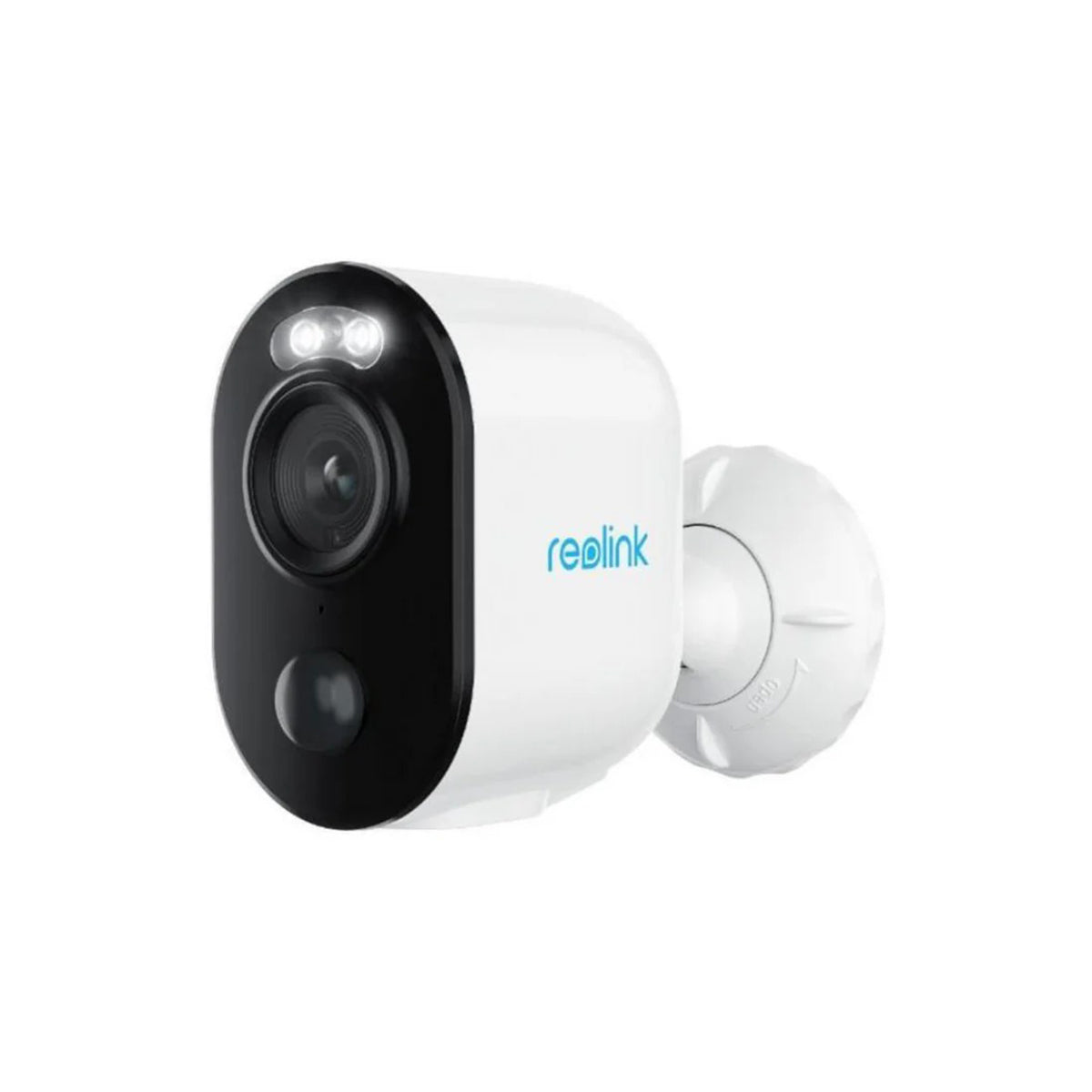
Which Reolink Argus 3E model should you choose? 2026 Hong Kong battery security camera comparison (from HK$399)
What exactly is the Argus 3E's positioning?
The Argus 3E is the entry-level price point of Reolink's battery camera range: 3MP resolution, a fixed lens (cannot be remotely panned or tilted), a built-in rechargeable battery and outdoor weatherproofing. Its value is not in its specifications, but inbringing the entry threshold for “no cabling, no power outlet and no monthly fee” down to HK$399.
Rental flats, old buildings, tong lau, village houses, warehouses, construction sites and temporary exhibition booths—these are places where drilling walls and running power cables is often not possible, and where people do not want to sign a CCTV maintenance contract. The 3E exists for precisely these scenarios. Mount it, connect it to Wi-Fi and add it in the mobile app, and setup is complete in around 10 minutes.
It is also the price anchor for the entire lineup: once you know the 3E sells for HK$399, you can see exactly what each additional dollar gets you on the more expensive models—higher resolution, pan-and-tilt functionality, dual lenses, solar power or 24/7 continuous recording. The details are broken down below.
Complete lineup pricing (read live from the product pages)
The prices in the table below are not hard-coded. They are retrieved directly from your website's product data when the browser loads, so they will always match the product pages. Out-of-stock models will still display their prices, but please open the product page to confirm availability.
Prices are read live from SHOPLINE product data. Please refer to the product page for the latest update. The table above does not include 4G models (Go / Altas Go / TrackMix LTE series) or the PoE wired series.
Official Specification Comparison (Verified Items Only)
The figures in the table below are taken from Reolink’s official product pages. Fields not published by the official source are marked “—” and are not filled in—figures circulating online often contradict one another.
The official pages for Argus 3E/3 Pro/PT Ultra do not specify a waterproof rating (IP); they only state outdoor weatherproof. This article does not fill in the blank. The official Altas PT Ultra page states IP65 under “Extra Features”, while the FAQ states IP66. The two sources are inconsistent, so please confirm with the distributor before placing your order.
Three Decisive Questions
1. Do you need pan-and-tilt functionality?
Once installed, fixed-lens models (3E、MagiCam、3 Pro、B360、3 Ultra) only cover one direction, with a viewing angle that covers approximately one doorway or one corridor. Pan-tilt models (B420、B340、PT、PT Ultra、Altas PT Ultra) can be controlled left, right, up, and down via your phone, allowing a single camera to cover several times more area.
The practical difference:For a 20-foot-wide shop where you need to monitor both the cash register and the entrance at the same time, one fixed camera is not enough—you need two. A pan-tilt camera can scan both areas, but it can only monitor one direction at a time.If you need to monitor both sides “at the same time”, the answer is the dual-lens Argus 4 Pro, not a pan-tilt camera.
The price difference is clear: moving from the 3E (HK$399) to the B420 (3MP pan-tilt) costs approximately HK$320 more. This is the most cost-effective upgrade in the entire series—you spend just over HK$300 more for pan-and-tilt functionality, immediately gaining much wider coverage.
2. Do you need 2K or 4K?
3MP is approximately 2,304×1,296, 2K (5MP) is approximately 2,560×1,920, and 4K (8MP) is approximately 3,840×2,160. The practical impact is on“The distance at which you can recognize someone’s face”:
- 3MP: Recognizable facial features within 3–5 meters; beyond 10 meters, you can only tell that someone is there
- 5MP: Recognizable faces at 5–8 meters, with clearer license plates
- 8MP: Faces and details remain identifiable at around 10 meters, making it suitable for parking lots, warehouses, and the road outside a main entrance.
If you only want to know whether someone passed by and when it happened, 3MP is enough. If you need footage for the police, want to identify a license plate, or see who took a package, go straight for 8MP—don't compromise to save a little.
3. Do you need solar power or 24/7 recording?
The 3E runs purely on battery, and actual battery life depends on the number of triggers and the weather. At a doorway with a dozen or so triggers per day, you may need to recharge it once every two to three months; at a shop with people coming and going all day, it may need charging every two to three weeks. You have to take it down each time you charge it, and if it is installed two or three meters high, that is a real inconvenience.
There are two solutions:Add a solar panel(Argus Solar includes one, or you can add a Solar Panel 3), orSwitch to 24/7 continuous recordingwith the Altas series (which has a larger built-in battery and solar power, allowing continuous recording without relying on motion triggers).
Note: Solar panels need sunlight. In Hong Kong tenement-building courtyards, indoors, or under covered walkways, solar power will not help—you will still need to remove the camera and charge it periodically.
Three limitations of the Argus 3E to know before you buy
1. 3MP is the minimum acceptable resolution in 2026.It is still usable, but when placed next to a 5MP model, the difference is clearly visible to the naked eye. If you plan to use it for three to five years, spending a few hundred dollars more for 5MP will likely be worth it.
2. Fixed viewing angle—install it in the wrong position and you will need to drill new holes.The 3E has no pan-and-tilt function. Before installation, use tape to mark the position and check the view with your phone to confirm the angle before tightening the screws.
3. Battery-only, with no solar power.If you want solar power, you need to buy a Solar Panel 3 separately. The total cost is close to buying an Argus Solar directly, so keep this in mind when comparing prices.
Which model to choose for each situation
Argus 3E. HK$399, with the lowest-risk entry point.
Argus B420(3MP pan-and-tilt)or B340(5MP pan-and-tilt).
Argus 3 Ultra or PT Ultra(8MP 4K).
Argus 4 Pro, with dual cameras and a 180° view.
Argus Solar, or Altas(24/7 continuous recording).
4G series: Go Plus, Go PT Ultra, Altas Go PT.
Installation: three practical issues you will encounter
Wi-Fi signal.When a battery camera is installed outdoors, the Wi-Fi signal may need to pass through one or two walls. Before installation, stand at the planned position and test the signal with your phone. If it is below two bars, do not force it—the video may keep cutting out. If the signal really cannot reach the location, a 4G model is the only solution.
Memory cards.Battery-powered models rely on local storage via microSD(some models can be paired with Home Hub). Buy a card rated for surveillance use; ordinary cards can fail in high temperatures under direct sunlight. 64GB to 128GB is sufficient for one to two weeks of continuous overwriting at a typical shop.
Monthly fees.Reolink does not force you to pay for cloud storage. Local storage on a microSD card can run completely free of charge. Cloud storage is only needed if you want footage to remain available even after the camera has been removed.
Warranty
All the products mentioned above are official Hong Kong stock, covered by the Hong Kong distributor's warranty and serviced locally, so you do not need to send them overseas. Batteries are consumable components, and normal warranty coverage generally does not include natural battery degradation. Please refer to the warranty terms on the product page before purchasing.
Frequently asked questions
Both the Argus 3E and B420 are 3MP. Why does the B420 cost more than HK$300 extra?
The difference is the pan-and-tilt function. You can control the B420's viewing direction remotely with your phone, so one camera covers a much larger area than the fixed-lens 3E. The resolution is the same, but the flexibility is not.
Is 3MP enough to see a person's face clearly?
Within 3 to 5 meters, you can identify facial features; beyond 10 meters, you can only tell that someone is there. If you need to identify people or license plates, choose 5MP or 8MP.
How often does a battery camera need to be recharged?
It depends on the number of triggers. At a residential doorway with a dozen or so triggers per day, it lasts around two to three months; at a shop with people coming and going all day, it may last only two to three weeks. Adding a solar panel can greatly extend battery life, but it requires sunlight.
Can I use it without a monthly fee?
Yes. Insert a microSD card for local storage, with no cloud subscription required. Consider cloud storage only if you need off-site backups.
Will it break if installed outdoors?
The entire Argus range is designed for outdoor use with weatherproofing. Actual service life depends on the installation location—any brand will age faster if it is exposed to prolonged direct afternoon sun or standing water.
Related Reading
Want to see how to configure a complete Reolink system (cameras + NVR + PoE switch), or how to calculate a shop CCTV budget? Refer to our Shop Anti-Theft CCTV Solution Cost Breakdown and Complete Comparison of Reolink Battery Cameras。For overseas buyers (Singapore / UK / Australia), please see English guides。
The prices in this article are read in real time from SHOPLINE product data. Pixel count and form factor are based on the original manufacturer's model specifications; detailed specifications such as detection methods, night vision, and battery life are subject to the respective product pages and the manufacturer's published information. Stock levels may change; please confirm before placing an order.