
Quick answer:In Hong Kong, buying a charger starts with asking, “Which device are you charging?” A 65W charger is already enough for a MacBook Air (35–67W), while a 14-inch MacBook Pro requires 96W or more, so 100W is a safe upper limit. For power banks, the Civil Aviation Department requires those under 100Wh to be carried in hand luggage, not checked in, with a maximum of two per person; 10,000mAh is about 37Wh and 20,000mAh is about 74Wh, both well below the limit. The actual restriction is “two units,” not capacity.
- 37Wh|The actual energy of a 10,000mAh power bank (10 × 3.7 = 37Wh); the Civil Aviation Department limit is 100Wh
- 96W|The original charging power of the 14-inch MacBook Pro; a 65W charger can only charge it slowly
- 147 products|The actual number of in-stock chargers/power banks/travel adapters in our store (verified on 2026-11-08)
- 0 articles|Before this, we had no articles about charging products at all—this is the category with the highest sales but the least content coverage
Can you take a power bank on a plane? Calculate Wh yourself first—don’t look at mAh
Airlines look atwatt-hours (Wh), not mAh. There is only one formula:mAh ÷ 1000 × 3.7 = Wh(3.7 is the nominal voltage of a lithium battery). So 10,000mAh = 37Wh, 20,000mAh = 74Wh, and 25,000mAh = 92.5Wh.
The Hong Kong Civil Aviation Department’s 《Air Passenger’s Guide to Baggage》 (revised edition dated 2026-03-28) sets out the following requirements for lithium-battery power banks:They may only be carried in hand luggage, may not be checked in, are limited to a maximum of two per person, must not be charged onboard, and should not be used onboard. In other words, both 37Wh and 74Wh are within the limit,what really restricts you is the “two per person” rule, not the capacity.
How different are 65W and 100W in practice? A comparison by device
Most complaints about “not charging enough” are actually caused by buying a charger with a lower wattage than the original charger. Using the wrong wattage will not damage the device, but it willlose battery while in use—especially during video calls or when running Docker.
| Your device | Original charging power | Is 65W enough? | Is 100W enough? |
|---|---|---|---|
| MacBook Air M2/M3 | 35W or 67W | Enough (the 67W version will be slightly slower) | More than enough |
| 14-inch MacBook Pro | 96W | Not enough; can only charge slowly | Just enough |
| 16-inch MacBook Pro | 140W | Clearly not enough | Charges slowly and loses battery while in use |
| iPad Pro | 20W–35W | Far more than needed | Overkill |
| iPhone | 20W–30W | Far more than needed | Wasteful |
| Windows thin-and-light laptop (65W PD) | 65W | Just right | With some headroom |
| Gaming laptop (180W or above) | 180W+ | Completely insufficient | Completely insufficient |
Conclusion:65W is the practical lower limit for an “all-in-one” charger, while 100W is the safe upper limit.For a 16-inch MacBook Pro or a gaming laptop, don’t expect a PD charger to replace the original power brick—that’s a physical limitation, not a brand issue.
In Hong Kong, a “foldable charger” is actually not very useful—this is a physical fact of UK-style plugs
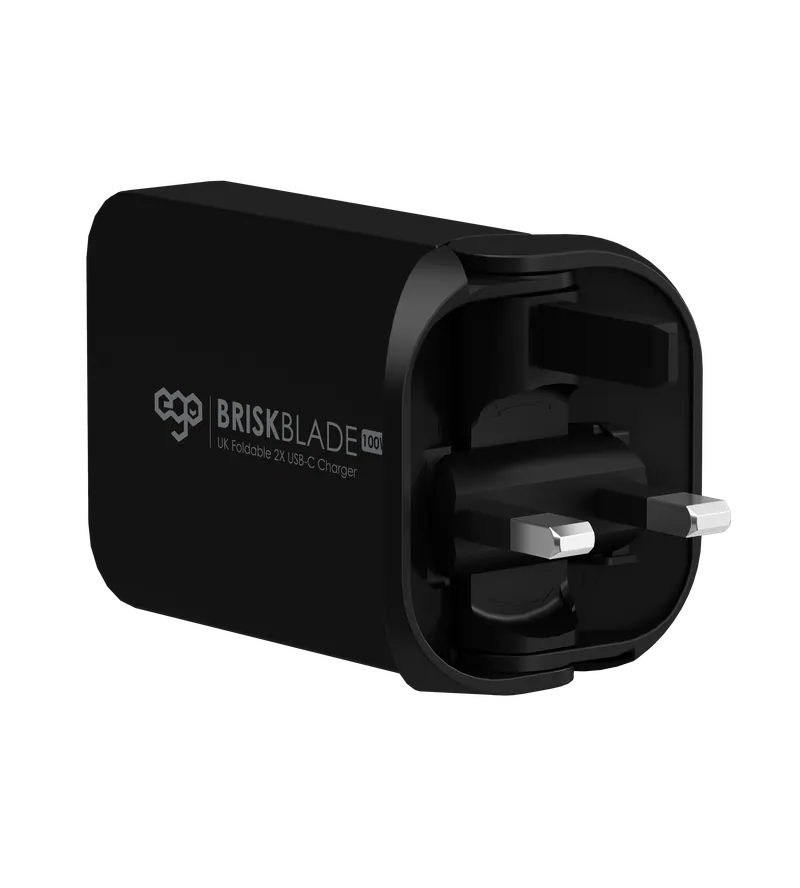
The many “folding-prong” chargers on the market fold theUS-style two-prong (Type A)/Japanese-styleplug prongs. In Hong Kong, we useUK-style three-prong (Type G)plugs, which already have three square prongs,so they don’t get any smaller whether folded or not。Therefore, in Hong Kong, the only benefit of a foldable design is that it “won’t scratch other items in your bag”—not that it saves space.
What deserves more attention is that UK-style three-prong plugs are bulky, and when plugged into a horizontal power strip, they will usuallyblock the adjacent socket。Before buying a multi-port charger, first check the spacing between the sockets on your power strip—this is the most common practical issue in Hong Kong homes, yet one that review articles rarely mention.
What is GaN? Smaller doesn’t mean cooler
GaN (gallium nitride) replaces traditional silicon as the switching component, allowing operation at higher frequencies, so the transformer coils and capacitors can be made smaller.The result is a smaller size and slightly higher efficiency at the same power output。
But one counterintuitive point needs to be made clear:A smaller size means less surface area for heat dissipation。With the same 100W output, a body that is half the size means the heat is concentrated over a smaller surface. So “GaN is guaranteed to run cool” is wrong—GaN is more efficient, not heat-free. When running at full load for an extended period (for example, charging a laptop and phone at the same time), it is normal for the charger to feel hot to the touch. The key is whether it has power-reduction protection.
Why does a magnetic power bank get hot? The efficiency problem with wireless charging
The actual efficiency of wireless charging is around 50–70%, with most of the remaining energy converted into heat. This is physics, not a quality issue. So it is expected for a magnetic power bank to feel hotter than a wired power bank.
Two practical guidelines:① If your phone case is thicker than 3mm or contains metal, magnetic alignment may be off, further reducing efficiency and making it noticeably hotter;② Use a wired connection when you’re in a hurry or in a hot environment (such as inside a car in summer), and save magnetic charging for situations where you just want to “top up on the go.”
Can’t charge at 65W? Nine times out of ten, it’s the cable, not the charger
This is the most common misdiagnosis: you buy a 100W charger, plug it into a laptop, and it only shows 45W or 60W, so you assume the charger is faulty.In reality, the limitation is the cable.
A USB-C cable needs a built-in E-Marker chip to support 5A current; without an E-Marker, the protocol limits the current to 3A. Even if the charger supports 100W, the actual power will be capped at 60W. Many cables included with devices only support USB 2.0 specifications, so they cannot reach higher power either.
How to check: see whether the cable is labeled 100W/5A/240W。If it isn’t labeled, treat it as a 60W cable.
Three form factors, three uses
| Form factor | Suitable for | Not suitable | Our store examples (actual prices) |
|---|---|---|---|
| Foldable wall charger (single unit) | Business trips, carrying only one or two devices | Charging multiple devices at home simultaneously | EGO 100W Blade HK$328 |
| Desktop charger (multiple ports) | A fixed desk, shared by the whole family | Carry it outside (heavy) | MOMAX 1-Charge Flow 4 Port 80W HK$209 |
| Travel adapter (built-in multi-country plugs) | International business trips, solving everything with one outlet | For use only in Hong Kong (large plug) | VERBATIM GaN III 140W HK$468 |
Choose directly by scenario (no need to compare specifications)
| Your situation | Recommendation | Reason |
|---|---|---|
| Charging only a phone + iPad | 45–65W single-port or dual-port | Anything higher is overkill; the phone itself is limited to below 30W |
| MacBook Air + phone | 65W dual-port | The Air supports up to 67W, so dual-port power distribution is just right |
| MacBook Pro 14 + phone + iPad | 100W with three or more ports | Reserve 96W for the laptop and distribute the remainder |
| One-week business trip | 100W foldable charger + 10,000mAh magnetic power bank | One wall charger and one portable charger |
| Traveling to Japan / the UK / Australia | 100W or higher travel adapter | Solve plug compatibility issues with one outlet, aside from voltage |
| Long-haul flight, need to charge a laptop | 25,000mAh (92.5Wh) | Close to 100Wh without requiring approval |
Our store's in-stock prices (verified 2026-11-08)
Wall chargers
| Model | Power | Features | Price |
|---|---|---|---|
| VERBATIM 65W Mini GaN (with display) | 65W | UK plug, power display | HK$248 |
| VERBATIM 140W Mini GaN (with display) | 140W | 16-inch MacBook Pro-class | HK$388 |
| EGO 100W Blade Brisk Blade | 100W | Foldable, ideal for travel | HK$328 |
| VERBATIM 4 Port 240W PD 3.1 | 240W | New PD 3.1 standard, four ports | HK$588 |
| MOMAX ONE PLUG GaN 100W four-output | 100W | Four ports, desktop use | HK$328 |
| MOMAX 1-Charge Flow 4 Port 80W | 80W | Four ports, compact size | HK$209 |
Power Bank
| Model | Capacity / Energy | Features | Price |
|---|---|---|---|
| EGO MagPower 6(Qi2.2) | 10,000mAh / 37Wh | Magnetic attachment, traceable QR code | HK$309 |
| EGO MagPower 6C(45W) | 10,000mAh / 37Wh | Magnetic attachment + 45W wired charging | HK$258 |
| MOMAX 1-Power F.Pass+ 10,000mAh | 10,000mAh / 37Wh | Magnetic attachment with built-in cable, CCC certified | HK$229 |
| MOMAX Q.Mag X2 20,000mAh | 20,000mAh / 74Wh | Ultra-thin magnetic attachment, 35W | HK$389 |
| MOMAX 1-Power 145W 25,000mAh | 25,000mAh / 92.5Wh | Close to the 100Wh limit, can charge a laptop | HK$659 |
Travel Adapter
| Model | Power | Features | Price |
|---|---|---|---|
| VERBATIM GaN III 140W Universal Travel Adapter | 140W | Built-in international plug pins | HK$468 |
| VERBATIM Charge n Travel 100W | 100W | Includes USB-C cable | HK$358 |
| MOMAX 1-World 120W GaN | 120W | Four ports | HK$459 |
| MOMAX 1-World 170W GaN | 170W | Four ports, high power | HK$509 |
| MOMAX 1-World2 205W Seven-Port | 205W | Dual AC, seven ports | HK$739 |
Frequently Asked Questions
Will a 65W charger damage a 16-inch MacBook Pro when charging it?
No, but the battery will gradually drain while in use. The PD protocol negotiates automatically, and the charger will only provide the power it is capable of delivering; it will not force an output. The issue is that under sustained high loads, 65W is less than the device’s power consumption, so the battery level will slowly drop.
Can a power bank be checked in?
No. The Civil Aviation Department stipulates that lithium battery power banks may only be carried in hand luggage and cannot be checked in. Each person may carry a maximum of two, and they must not be charged or used to charge other devices on board.
Are GaN chargers necessarily cooler than traditional chargers?
No. GaN chargers are slightly more efficient, but at the same power output they are smaller and have a smaller heat-dissipation area, so their surface temperature is not necessarily lower. To assess quality, check whether they have over-temperature power-reduction protection rather than judging by how cool they feel to the touch.
Is a magnetic power bank being very hot a sign that it is faulty?
No. Wireless charging efficiency is approximately 50–70%, so the remaining energy inevitably turns into heat. If the phone case is thicker than 3mm or contains metal, misalignment will further reduce efficiency and increase the temperature.
Why does a 100W charger only charge at 60W?
In most cases, it is the cable. USB-C requires an E-Marker chip to support 5A; without an E-Marker, the cable’s protocol is limited to 3A, capping the actual power at 60W. Check whether the cable is marked 100W/5A/240W.
Are folding chargers worthwhile in Hong Kong?
They are useful for storage because they will not scratch items inside your bag, but they do not save space—the UK-style three-pin plug already consists of three square pins and cannot really be folded away. Instead, note that the large UK-style plug may block the adjacent socket on a power strip.
Sources and Methodology
Prices and stock: SHOPLINE product API, retrieved on 2026-11-08, covering 147 active charging/power bank/travel adaptor products. In-flight regulations: the Hong Kong Civil Aviation Department’s 《Know Your Baggage》, revised on 2026-03-28. Wh conversion: mAh ÷ 1000 × 3.7V (nominal lithium battery voltage). USB-C power negotiation: under the USB PD 3.0/3.1 specifications, a 5A current requires an E-Marker cable. The wireless charging efficiency range reflects commonly measured results for inductive wireless charging. This article does not include any review samples provided by manufacturers.
DIGIBAL ONLINE Editorial Department|Hong Kong online electronics retailer specialising in charging, audio-visual products, smart home devices and CCTV. Prices in this article are sourced from the official API and marked with the verification date; this is not manufacturer-supplied content.
Last proofread: 2026-11-08