
Projectors for Singapore, the UK and Australia: how to choose one that actually gets used
Projector Guide · LED / Laser · Google TV · Ultra Short Throw · SG / UK / AU 2026
In 30 seconds: for a bedroom or a rented flat, a HK$700-1,400 portable 1080p unit is genuinely enough. For a living room you watch with some light on, budget HK$2,500-4,000 for 1,200-1,600 ANSI. If you cannot drill the ceiling, ultra short throw solves a problem that no amount of brightness will. For colour, look at triple laser. Twenty-eight models below, priced in four currencies.
Quick picks
- Cheapest usable: DIGIBAL C260
- Best value 1080p: DIGIBAL x Hotack N2W
- Travel: YABER L1 Pro (0.88 kg)
- Ceiling projection from the bedside: Yaber T1 Pro
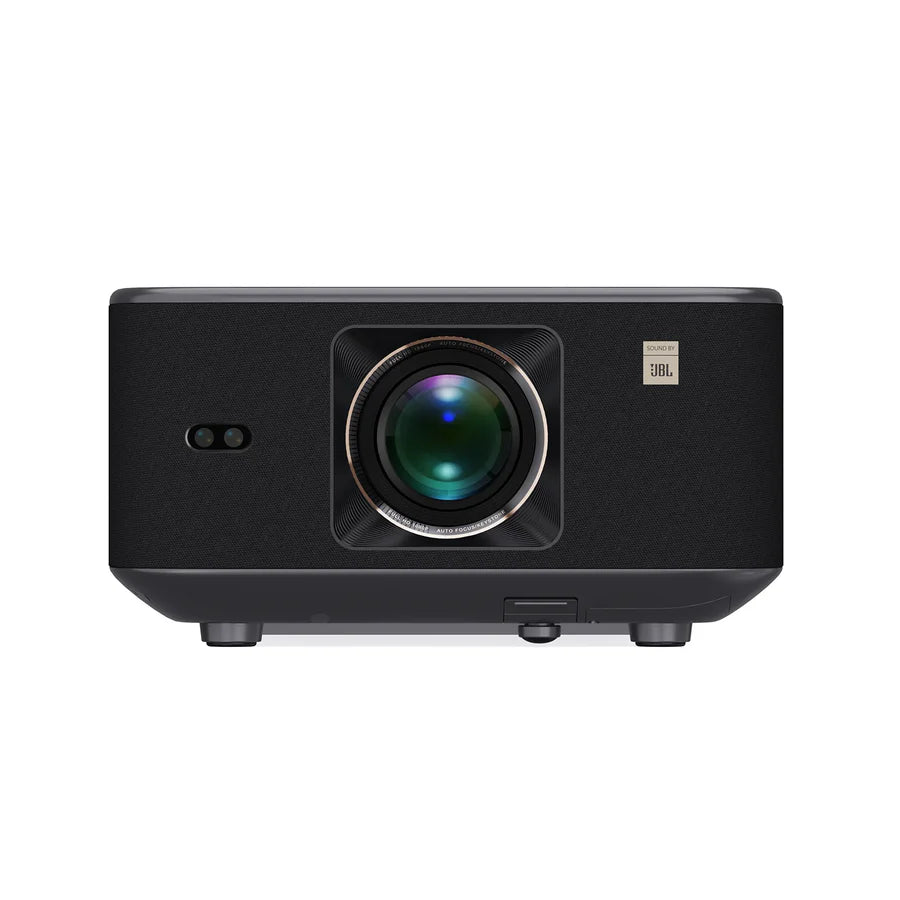
- Built-in Google TV: DIGIBAL C600 or HOTACK X7AD
- Living-room main screen: Yaber K3 (1,600 ANSI)
- Against-the-wall UST: Yaber K300s
- Best colour: XGIMI MoGo 4 Laser
Four questions settle the model
1. When will you use it?
This sets your brightness requirement and therefore your budget. Dark room at night: 800 ANSI is plenty. Afternoon with curtains open, or an office: 1,500 ANSI and up, and the price steps up with it.
2. How big, and from how far?
Under 60 inches, 720p is acceptable. 80-100 inches needs 1080p. Above 120 inches, look at 4K or a strong 1080p unit. Also check the throw ratio - at the same distance, a lower ratio gives a bigger image. A typical spare room only has 2-2.5 m of throw, which caps most units at 60-80 inches.
3. Will it move?
Portability means built-in battery, low weight and auto focus. Fixed installation is the opposite: bigger body, higher output, possibly ultra short throw.
4. Can you mount to the ceiling?
In a rental, usually not. That leaves two options: sit it on a table and project straight on (you need the space, and anyone walking past breaks the beam), or place a UST unit against the wall. This constraint affects daily usability more than any specification.
Reading the specifications honestly
Brightness. ANSI, ISO and CVIA are not interchangeable. Use the thresholds above rather than comparing printed numbers across standards.
Resolution. Check native resolution, not "4K supported" - that usually means it accepts a 4K signal and outputs 1080p.
Light source. LED for long life and small size, laser for colour and longevity, lamp only if you specifically want cheap brightness and accept replacement lamps.
Throw and keystone. Throw ratio is distance divided by image width: 1.2:1 means 2.4 m gives roughly a 90-inch image. Digital keystone crops the frame; optical shift does not.
All 28 models, in four currencies
Hong Kong prices are read live from our product pages. Singapore, UK and Australian figures are converted at today's rate and rounded - a guide to relative cost, not a quote.
By budget
Entry: bedroom, rental, first projector
Everything at this level is LED and portable. The three features that matter are auto focus, auto keystone and a built-in OS - with those, you put it on a bedside table and watch, instead of spending half an hour adjusting it.
Mid: living-room secondary screen
From here you get 800-1,200 ANSI, gimbals, 360-degree projection and Google TV. If you will watch in daylight or project above 100 inches, this is the sensible landing point.
Flagship: main screen, ultra short throw, laser
1,600 ANSI and up, triple laser, ultra short throw. Before spending here, be honest about whether the room can be darkened. If the curtains stay open, the money is better spent on a TV.
Plugs, voltage and shipping
Every projector here runs from a mains adapter. Singapore, the UK and Australia are all 230V, so nothing needs converting. Singapore and the UK use the same Type G plug as Hong Kong, so a unit works out of the box in both. Australia needs a Type I adapter for the plug only - not a transformer. Several models ship with a region-specific plug variant, which is why you will see AU versions listed separately; tell us your destination and we will send the right one.
Delivery: Hong Kong 1-2 working days, Singapore 5-9, UK 6-10, Australia 7-12. Warranty is a Hong Kong warranty - we service locally, you cover return freight (about HK$150-350 each way) and the round trip takes 2-4 weeks.
Questions we get asked
Can I compare ANSI, ISO and CVIA lumen figures directly?
No. They are different measurement standards, and the same projector can be printed two or three times higher under one standard than another. CVIA is the Chinese domestic standard; ANSI and ISO test under different conditions. As a working threshold: 500-800 for a dark bedroom, 1,200-1,600 for a living room with some light, 2,000 and up if you genuinely need daytime viewing.
How much difference does 720p versus 1080p make?
Below about 60 inches and at 2-3 metres, very little. Above 100 inches, or with subtitled content, 1080p is clearly sharper. 4K only earns its price at large sizes with 4K source material - and note that many cheap "4K supported" projectors only decode 4K input while outputting 1080p. Look for native resolution.
LED, laser or lamp?
Lamps are bright but short-lived (3,000-5,000 hours) and need replacing. LED runs 20,000+ hours, starts instantly and is compact - this is the mainstream now. Laser, especially triple/RGB laser, gives the best colour saturation and stability with the longest life, at the highest price. Every portable unit here is LED or laser.
Can I place it off to the side?
Most units have digital keystone correction, but software correction crops the frame and throws away real resolution - the larger the angle, the bigger the loss. Project straight on if you can. If you cannot, choose a model that advertises side projection or optical shifting rather than relying on keystone alone.
Is ultra short throw worth the money?
A UST projector sits 20-50 cm from the wall and produces 80-100 inches. You do not need a ceiling mount and nobody walks through the beam - which matters in small apartments. The trade-offs are price, and the wall must be flat: every mark and ripple is magnified.
Can a projector replace a TV?
Not in a bright living room. Contrast collapses with ambient light and blacks turn grey - that is physics, not a tuning issue. If you mostly watch at night, or can close the curtains, a projector is more immersive than a TV at the same price. The pragmatic answer for most homes is a TV by day, a projector at night.
Does built-in Google TV matter?
A great deal. Without a smart OS you need a streaming stick or a laptop, which means another cable and another remote. A built-in Google TV or Android unit boots straight into Netflix, YouTube and Disney+, which is the difference between using it and not bothering.
What happens when the light source wears out?
LED and laser sources are rated 20,000+ hours - at three hours a day that is 18 years, so in practice you will never replace one. Lamp projectors need a budget for replacement lamps. Check whether the quoted figure is lamp life or light-source life.
Before you order
- Throw distance measured, and image size calculated from the throw ratio
- Placement decided: table, bedside, cabinet or ceiling
- Battery needed or not
- Built-in Google TV needed or not
- Brightness chosen for your actual room, not by the biggest number
- Native resolution confirmed
- Blinds or blackout arranged - ambient light is the real enemy
- Destination plug type confirmed (SG/UK Type G, AU Type I)
Resolution, brightness, light source and projection method are taken from product names and manufacturer markings. ANSI, ISO and CVIA figures are not directly comparable and the thresholds above are practical guidance, not a conversion. Hong Kong prices are read live from our product pages; SGD, GBP and AUD are converted at the rate published on 28 October 2026 and exclude shipping, duties and taxes. Stock and lead time: check the product page or ask us.